
Third-Party APIs Are Part of Your Attack Surface
Understanding unsafe API consumption and the security risk of external dependencies.
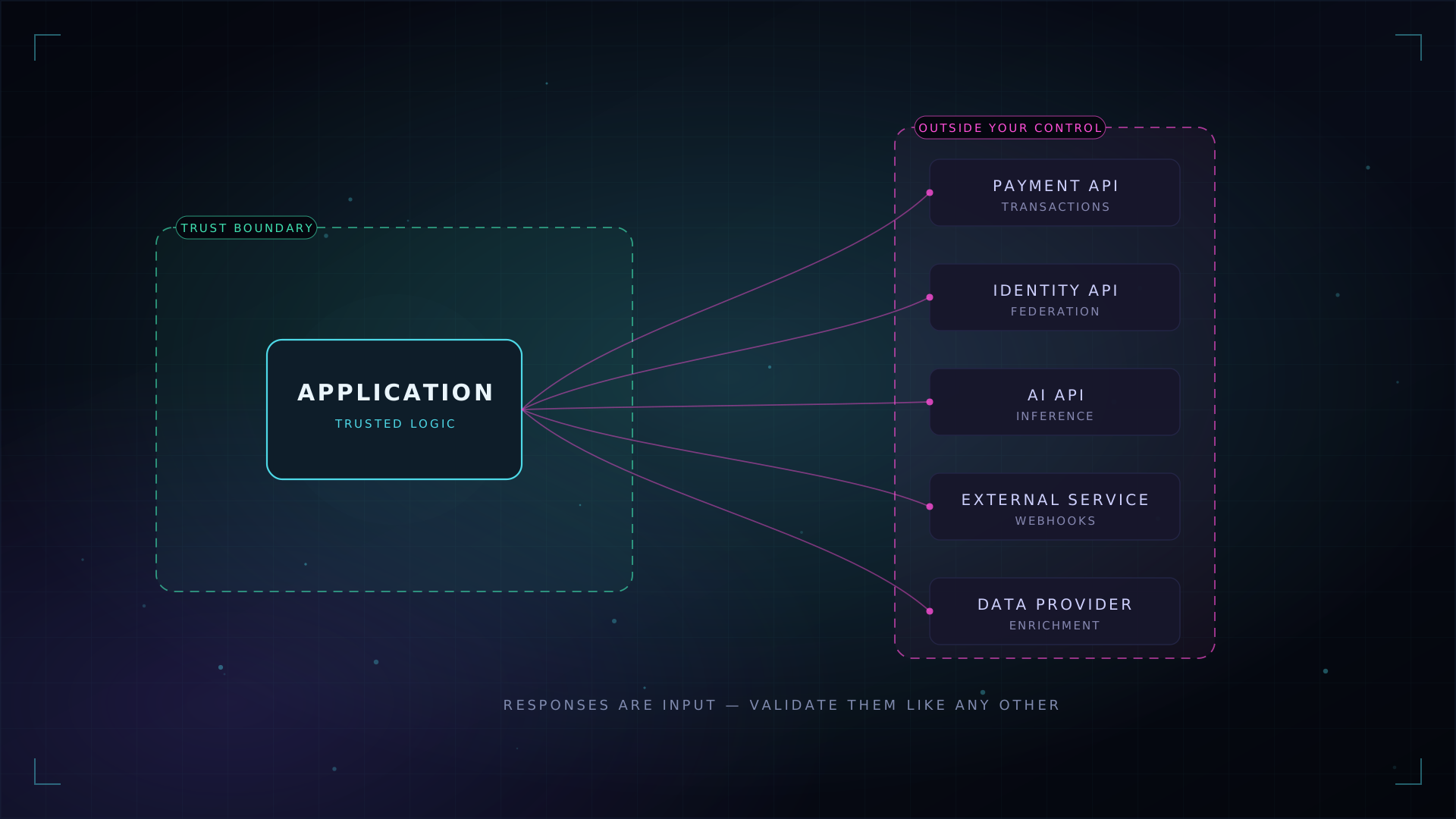
A typical product now calls a payment processor, an identity provider, an analytics service, one or more cloud APIs, an AI inference endpoint, a messaging platform and several data providers. Each integration is a network path out of the trust boundary and a response path back into it.
Teams generally validate what users send them. They rarely apply the same scrutiny to what vendors send back. The asymmetry is understandable — the vendor is a paying relationship with a contract — and it is not a security argument. A response is input. Its origin does not change what it can do when it reaches a parser, a template or a database.
What unsafe API consumption looks like
- Unvalidated responses. Vendor output written to a database, rendered into a page or passed to an interpreter without type, range or encoding checks.
- Assumed authentication. A webhook accepted because it arrived at the expected URL, with no signature verification.
- Assumed authorization. A vendor's positive answer treated as an entitlement decision the vendor was never asked to make.
- Unbounded trust in redirects. Following whatever location the third party returns, into internal address space.
- No failure design. Undefined behaviour when the dependency is slow, unavailable, or returns something unexpected. Frequently this fails open.
- Silent contract drift. The vendor changes a field, adds a value to an enum, or alters pagination, and nothing detects it until behaviour changes.
- Over-scoped credentials. One API key with far more permission than the integration requires, shared across services and rarely rotated.
The webhook case is worth isolating because it inverts the usual direction. A webhook endpoint is a publicly reachable, unauthenticated-by-default entry point into your application that is designed to trigger state changes. Treat it as an API you own, because it is.
Where the boundary actually sits
your application
  | validate  <-- inbound user requests        (usually done)
  | validate  <-- inbound vendor responses     (often skipped)
  | validate  <-- inbound webhooks             (often skipped)
  v
internal systems, database, rendering
Drawing it this way makes the gap obvious. The same three arrows point inward; only one of them is routinely defended. The other two arrive from systems you do not operate, cannot patch, and will not be told about in advance when they change.
Failure modes worth testing
| Condition | Question to answer |
|---|---|
| Dependency times out | Does the operation fail closed, or proceed without the check? |
| Dependency returns an error | Is the error handled, or does it become a null that means "allowed"? |
| Response schema changes | Is it detected, or silently coerced? |
| Unexpected enum value | Default branch — deny or allow? |
| Response much larger than expected | Any bound on size or processing time? |
| Webhook replayed | Is the operation idempotent? Is the timestamp checked? |
| Webhook forged | Is the signature verified against a current key? |
| Vendor credential leaks | What is the blast radius of that single key? |
Most of these are cheap to test and rarely tested, because they require inducing failure in something that normally works. That is precisely why they survive into production.
Security review checklist
- Inventory every external API the application calls, including those reached by libraries and SDKs
- Classify each by the sensitivity of data exchanged and the impact of compromise
- Validate responses against an explicit schema — type, range, length, encoding
- Verify webhook signatures and enforce timestamp windows and replay protection
- Enforce authentication outbound and authorization internally; never delegate an entitlement decision
- Enforce TLS with certificate validation on every outbound call, including internal service hops
- Scope credentials to the minimum required, store them in a secret manager, and rotate them
- Define and test failure behaviour: timeouts, retries with backoff, circuit breaking, fail-closed defaults
- Assign an internal owner to each integration who is accountable for reviewing vendor changes
- Monitor for contract drift and alert on unexpected response shapes
- Bound outbound requests so a compromised dependency cannot reach internal address space
Conclusion
Third-party integration risk is not primarily about vendor due diligence, useful though that is. It is about the code on your side of the boundary: whether it validates what it receives, whether it fails closed, and whether anyone would notice if the contract changed.
Those are engineering properties, entirely within your control, and they are where the review effort produces the most.
References
- OWASP API Security Top 10 — Unsafe Consumption of APIs
- OWASP API Security Project
- OWASP SSRF Prevention Cheat Sheet
Bring this to your own environment.
If any of the above describes a system you are responsible for, the fastest next step is a conversation about scope.