
ISO 27001 vs SOC 2 vs PCI DSS: Comparison Guide
A side-by-side comparison of what ISO 27001, SOC 2 and PCI DSS actually ask, what each produces, and how organizations typically choose between them.
Executive summary
ISO 27001, SOC 2 and PCI DSS are the three compliance frameworks organizations most often need to address, and they’re frequently confused with one another despite asking fundamentally different questions and producing different outcomes. ISO/IEC 27001:2022 is a certification: an organization’s information security management system is confirmed to meet the standard. SOC 2 is not a certification — it’s an examination that produces an attestation report, evidencing that a service organization’s controls operated as described. PCI DSS isn’t optional in the way the other two are: it’s a requirement, published and governed by the PCI Security Standards Council, for any organization that stores, processes or transmits payment card data. This guide compares what each framework actually asks, what it produces, who typically pursues it, and how organizations often combine more than one. It’s TMG Security’s own comparison — built from the readiness work we do directly with clients, and checked against each framework’s official published source — and it doesn’t replace the official documentation for any of the three.
At a glance
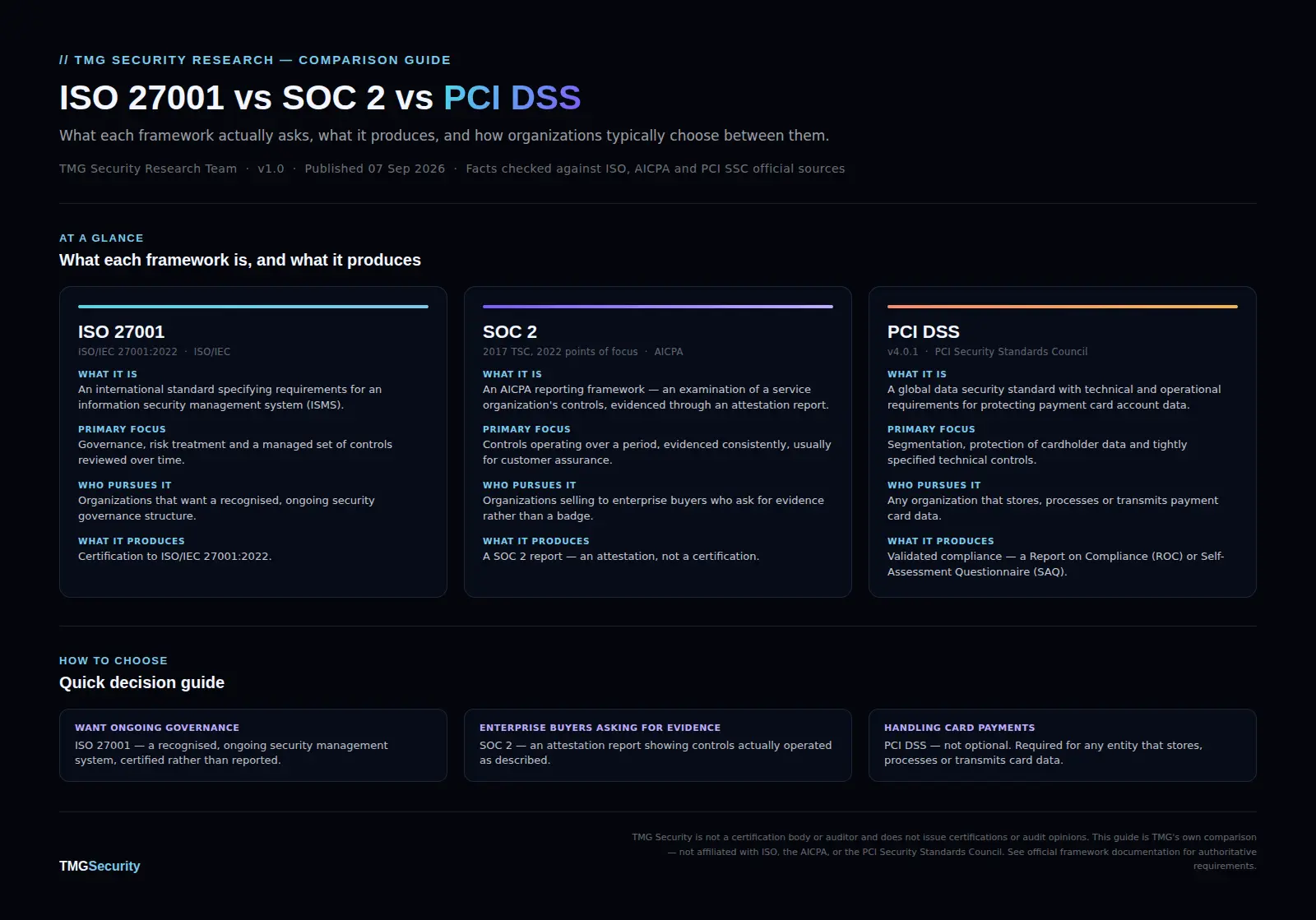
Quick comparison
Every cell below is either TMG Security’s own published characterization of these frameworks, or a fact checked directly against each framework’s official source (ISO, AICPA, or the PCI Security Standards Council) — see References at the end of this guide.
| Dimension | ISO 27001 | SOC 2 | PCI DSS |
|---|---|---|---|
| What it is | An international standard specifying requirements for an information security management system (ISMS). | An AICPA reporting framework — an examination of a service organization’s controls, evidenced through an attestation report. | A global data security standard with technical and operational requirements for protecting payment card account data. |
| Primary focus | Governance, risk treatment and a managed set of controls reviewed over time. | Controls operating over a period, evidenced consistently, usually for customer assurance. | Segmentation, protection of cardholder data and tightly specified technical controls. |
| Who typically pursues it | Organizations that want a recognised, ongoing security governance structure. | Organizations selling to enterprise buyers who ask for evidence of operating controls rather than a certification. | Any organization that stores, processes or transmits payment card data. |
| What it produces | Certification to ISO/IEC 27001:2022. | A SOC 2 report — an attestation, not a certification. | Validated compliance, documented via a Report on Compliance (ROC) or Self-Assessment Questionnaire (SAQ). |
| When it’s typically considered | When an organization wants a recognised, ongoing governance structure — not usually a single customer’s condition of signing. | When enterprise buyers are asking for evidence rather than a badge. | Not a choice in the same sense — required outright for in-scope entities. |
| Current version | ISO/IEC 27001:2022 (3rd edition, published October 2022; amended 2024) | Based on the 2017 Trust Services Criteria, with revised points of focus issued in 2022 | v4.0.1 (v3.2.1 retired March 31, 2024) |
| Governing body | ISO/IEC (ISO/IEC JTC 1/SC 27) | AICPA (American Institute of Certified Public Accountants) | PCI Security Standards Council (PCI SSC) |
| Structure | A managed set of controls organizations select from based on risk, detailed in Annex A / ISO/IEC 27002. | 5 Trust Services Criteria: Security, Availability, Processing Integrity, Confidentiality, Privacy. | 12 requirements organized into 6 goals. |
TMG Security did not include ISO/IEC 27001’s current Annex A control count or a Type I/Type II SOC 2 distinction in this guide, because neither could be confirmed from an official source at the time of publication — see the Scope and limitations section.
ISO 27001 in detail
ISO/IEC 27001:2022 is the current edition of the international standard for information security management systems — the third edition, published by ISO/IEC in October 2022, with an amendment published in 2024. It specifies requirements an organization’s information security management system (ISMS) must satisfy: governance, risk treatment, and a managed set of controls reviewed over time. Organizations that complete the process are described as certified to ISO/IEC 27001:2022.
TMG’s own readiness work with clients typically surfaces the same considerations: scope definition, risk methodology, the Statement of Applicability, management review and internal audit. The standard’s Annex A sets out the controls organizations select from based on risk, detailed further in ISO/IEC 27002:2022 — we’ve deliberately left the current control count out of this guide rather than repeat a figure we could not verify directly from ISO.
SOC 2 in detail
SOC 2 sits within the AICPA’s System and Organization Controls (SOC) suite of CPA service offerings, rather than being a standard an organization is certified against. The AICPA and the licensed firms that perform this work describe it as an examination that produces an attestation report — not a certification. It’s built on the AICPA’s Trust Services Criteria: Security, Availability, Processing Integrity, Confidentiality and Privacy, most recently the 2017 Trust Services Criteria with revised points of focus issued in 2022.
TMG’s own readiness work for this framework typically covers criteria selection, control design, and evidence collection over the review period — the report’s value comes from demonstrating that selected controls operated consistently, not from a one-time check.
PCI DSS in detail
PCI DSS is a global standard, published and governed by the PCI Security Standards Council, providing a baseline of technical and operational requirements to protect payment card account data. It applies to entities that store, process, or transmit cardholder data and/or sensitive authentication data. The current version is v4.0.1 (v3.2.1 retired March 31, 2024), and the standard remains organized into 12 requirements grouped under 6 goals.
TMG’s own readiness work for this framework typically covers scope reduction, network segmentation, key management, and logging and testing requirements. Depending on an organization’s size and how it processes card data, compliance is validated through a Report on Compliance (ROC) prepared by a Qualified Security Assessor (QSA), or a Self-Assessment Questionnaire (SAQ).
How to choose
These three frameworks answer different questions and are not interchangeable. ISO 27001 asks whether you are running a managed information security programme: it certifies a management system, not a point-in-time control set, and is usually chosen when an organization wants a recognised, ongoing security governance structure. SOC 2 asks whether your controls actually operated as described over a period of time: it produces a report for customer assurance rather than a certification, and is usually chosen when enterprise buyers are asking for evidence rather than a badge. PCI DSS is not a choice in the same sense — it is a requirement for any organization that stores, processes or transmits payment card data, with tightly specified technical controls around segmentation and cardholder data protection.
Using more than one framework
In practice, organizations often need more than one: a SaaS company selling to enterprises frequently pursues SOC 2 for customer assurance while working toward ISO 27001 for its broader security programme, and any organization handling card payments needs PCI DSS regardless of what else it pursues. Which combination applies depends on your sector, your customers and where you operate.
How TMG Security helps
TMG Security helps organizations understand which of these frameworks apply, evaluate existing controls against them, and identify what’s missing before an assessor, auditor or customer does. That work spans framework readiness for ISO 27001, SOC 2 and PCI DSS specifically, and — for organizations that want a broader baseline first — a standalone risk and compliance gap assessment.
Scope and limitations
- TMG Security is not a certification body or auditor, and does not issue certifications, attestations, or audit opinions for ISO 27001, SOC 2, PCI DSS, or any other framework.
- This guide is educational and comparative. It reflects TMG’s own comparison of these three frameworks, checked against official sources at the time of publication — it is not legal, regulatory, audit or certification advice.
- Official framework documentation always takes precedence over this guide. Consult ISO, the AICPA, and the PCI Security Standards Council directly for authoritative, current requirements.
- Standards and frameworks are revised over time — this guide reflects ISO/IEC 27001:2022, SOC 2’s 2017 Trust Services Criteria (2022 points of focus), and PCI DSS v4.0.1 as of the publication date above. Verify the current published version before relying on specific requirements.
- Two details were deliberately left out because TMG could not confirm them from an official source at publication: ISO/IEC 27001:2022’s current Annex A control count, and a formal SOC 2 Type I / Type II distinction.
References
This is TMG Security’s own comparison guide. TMG does not create, govern, certify, attest to, or audit against ISO 27001, SOC 2, or PCI DSS, and is not affiliated with ISO, the AICPA, or the PCI Security Standards Council.
TMG Security is not a certification body or auditor and does not issue certifications or audit opinions.