
Top Cybersecurity Companies in the USA (2026)
An editorial comparison of the technology vendors and service firms U.S. organizations evaluate most often — including how the two differ, where each one fits, and how to choose between them.
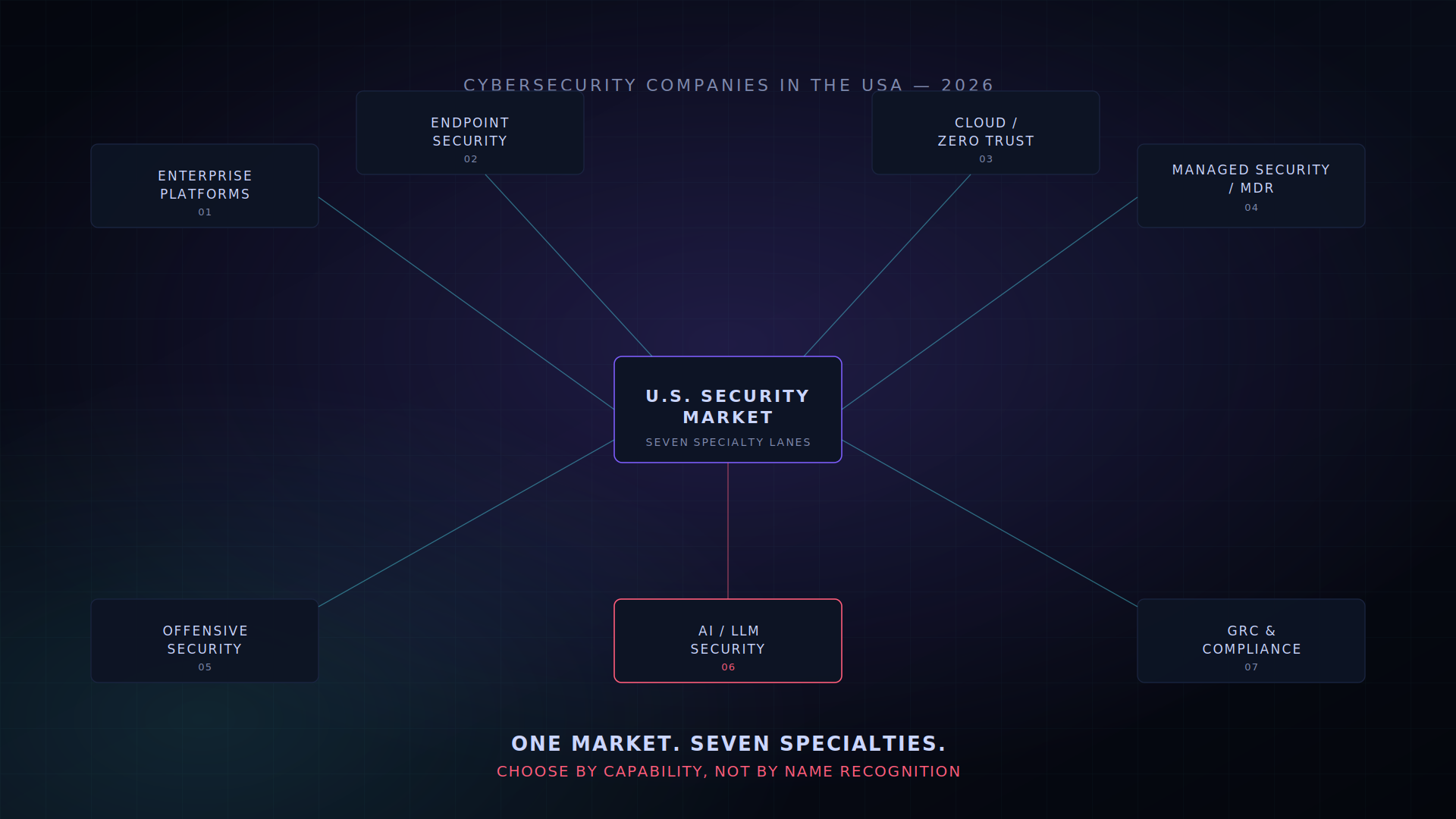
The top cybersecurity companies in the USA fall into two different categories that get compared as if they were one: cybersecurity technology vendors that build and sell security software and platforms, and cybersecurity service or consulting firms that sell hands-on expertise — testing, monitoring and advisory work performed by security professionals. Palo Alto Networks and CrowdStrike are technology vendors; Bishop Fox and TMG Security are service firms. Some companies, like Rapid7 and Arctic Wolf, sell a software-backed managed service that sits between the two. Which one is "best" depends entirely on what a buyer is trying to solve: a platform to operate in-house, or an outcome delivered by someone else's team.
This article compares 15 companies serving the U.S. cybersecurity market across enterprise security platforms, endpoint security, cloud and Zero Trust, managed security and MDR, offensive security and penetration testing, AI and LLM security, and GRC and compliance. TMG Security, the publisher of this article, is included using the same evaluation format as every other company on this list.
How We Selected These Cybersecurity Companies
Companies were selected and included using the following criteria. This is an editorial comparison based on publicly available information, not an independent market ranking or a certification of quality.
- U.S. presence. Each company has a verifiable U.S. headquarters, office, or documented U.S. operations serving American customers.
- Cybersecurity specialization. Cybersecurity is a core, not incidental, part of the company's business.
- Service or capability scope. The company offers a defined, identifiable set of cybersecurity capabilities — a product category, a service line, or both.
- Enterprise or business relevance. The company's offerings are relevant to organizations evaluating cybersecurity vendors or service providers, not solely consumer products.
- Technical expertise or research. The company demonstrates technical depth through its published research, methodology, or specialization (for example, a dedicated threat research or offensive security practice).
- Publicly verifiable information. Company facts used in this article — headquarters, founding year, and core capabilities — are drawn from each company's own published sources (primarily official websites and, where a primary source was unavailable, public reference sources such as Wikipedia).
- Specialization and use-case fit. Companies were chosen to give U.S. buyers real coverage across the specialty categories in this article, rather than repeating the same category multiple times.
No revenue figures, client counts, market-share estimates, or third-party rankings are cited in this article unless they come from a company's own published, publicly verifiable statements. Where that information was not publicly available, it has been left out rather than estimated.
Top Cybersecurity Companies in the USA
The 15 companies below are presented in category groups — enterprise platforms, endpoint, cloud and identity, managed security, offensive security, AI/LLM security, and GRC — rather than as a single ranked list. Each profile uses the same format: what the company is best known for, its key cybersecurity capabilities, who it's best suited for, its U.S. presence, and why it's included here.
Palo Alto Networks
- Best known for: Enterprise firewalls and network security platforms.
- Key cybersecurity capabilities: Next-generation firewalls, cloud security (Prisma Cloud), secure access service edge (SASE), and threat research through its Unit 42 division.
- Best suited for: Large enterprises standardizing security architecture around a single vendor platform.
- U.S. presence: Headquartered in Santa Clara, California; founded in 2005.
- Why it made this list: One of the most widely deployed enterprise security platform vendors in the U.S., with a dedicated in-house threat intelligence and incident response research arm.
Cisco
- Best known for: Networking equipment and network-centric security.
- Key cybersecurity capabilities: Firewall and threat management (its ASA/PIX lineage), secure internet gateway (Cisco Umbrella), intrusion detection and prevention through its Sourcefire acquisition, and threat intelligence via Cisco Talos.
- Best suited for: Organizations already standardized on Cisco networking infrastructure that want security integrated at the network layer.
- U.S. presence: Headquartered in San Jose, California; founded in 1984.
- Why it made this list: A long-established U.S. networking vendor whose security portfolio is deeply integrated into enterprise network infrastructure already in production at most large organizations.
Fortinet
- Best known for: Firewall appliances and its "Security Fabric" unified security architecture.
- Key cybersecurity capabilities: Next-generation firewalls, endpoint protection, intrusion detection and prevention, and converged network security and SD-WAN.
- Best suited for: Organizations that want a single, tightly integrated vendor ecosystem spanning network, endpoint and cloud security.
- U.S. presence: Headquartered in Sunnyvale, California; founded in 2000.
- Why it made this list: One of the largest U.S. network security platform vendors by installed base, with a broad hardware-plus-software product line.
CrowdStrike
- Best known for: Cloud-delivered endpoint detection and response (EDR/XDR).
- Key cybersecurity capabilities: The Falcon platform for endpoint protection and detection, threat intelligence, and incident response services.
- Best suited for: Organizations prioritizing endpoint visibility and rapid detection and response across a distributed workforce.
- U.S. presence: Headquartered in Austin, Texas; founded in 2011; publicly traded (Nasdaq: CRWD).
- Why it made this list: One of the most widely adopted endpoint security platforms among U.S. enterprises, built specifically around detection and response rather than traditional signature-based antivirus.
SentinelOne
- Best known for: AI- and machine-learning-driven autonomous endpoint protection.
- Key cybersecurity capabilities: Endpoint detection and response across PCs, servers, IoT and cloud workloads, with expanding generative-AI security capabilities following its acquisition of Prompt Security.
- Best suited for: Organizations wanting automated, AI-assisted threat detection and response with less reliance on manual analyst triage.
- U.S. presence: Headquartered in Mountain View, California; founded in 2013; publicly traded (NYSE: S).
- Why it made this list: A prominent alternative to legacy antivirus and EDR vendors, with a specific product emphasis on AI-driven detection.
Zscaler
- Best known for: Cloud-delivered Zero Trust network security.
- Key cybersecurity capabilities: The Zero Trust Exchange platform, secure access service edge (SASE) architecture, and cloud-native traffic inspection without traditional network security appliances.
- Best suited for: Organizations moving away from perimeter-based (firewall/VPN) security toward cloud-native, identity-based access control.
- U.S. presence: Headquartered in San Jose, California; founded in 2007.
- Why it made this list: One of the primary U.S. vendors associated with delivering the Zero Trust security model at cloud scale.
Okta
- Best known for: Identity and access management (IAM) and single sign-on (SSO).
- Key cybersecurity capabilities: Workforce and customer identity management, single sign-on, adaptive multi-factor authentication, and identity lifecycle management, including through its Auth0 acquisition.
- Best suited for: Organizations whose primary security priority is centralizing and securing identity across many applications.
- U.S. presence: Headquartered in San Francisco, California; founded in 2009.
- Why it made this list: Identity is a foundational component of Zero Trust architecture, and Okta is one of the most widely deployed independent identity platforms in the U.S. market.
Arctic Wolf
- Best known for: Managed detection and response (MDR) delivered as a service.
- Key cybersecurity capabilities: 24/7 security monitoring, alert triage and investigation, and incident response support layered on top of a customer's existing security tools.
- Best suited for: Mid-market organizations that need continuous monitoring and response without building an in-house security operations center.
- U.S. presence: Headquartered in Eden Prairie, Minnesota; founded in 2012.
- Why it made this list: One of the larger independent MDR-focused providers in the U.S., built specifically around a managed-service delivery model rather than a licensed security product.
Rapid7
- Best known for: Vulnerability management and managed detection and response.
- Key cybersecurity capabilities: Vulnerability assessment, attack surface management, next-generation SIEM, and managed detection and response services delivered through its Command Platform.
- Best suited for: Organizations that want vulnerability management and detection-and-response capability from a single connected platform.
- U.S. presence: Headquartered in Boston, Massachusetts; founded in 2000.
- Why it made this list: A long-standing U.S. vulnerability management vendor that has expanded into detection and response, giving it coverage across both proactive and reactive security operations.
Tenable
- Best known for: Vulnerability and exposure management.
- Key cybersecurity capabilities: The Nessus vulnerability scanner and the Tenable One exposure management platform, which consolidates vulnerability data across IT, cloud and identity systems.
- Best suited for: Organizations that need continuous, prioritized visibility into vulnerabilities and exposure across a large or complex environment.
- U.S. presence: Headquartered in Columbia, Maryland; founded in 2002.
- Why it made this list: Nessus is one of the most widely deployed vulnerability scanning tools in the industry, and Tenable remains one of the primary independent U.S. vendors in exposure management.
Mandiant (Google Cloud)
- Best known for: Incident response and threat intelligence.
- Key cybersecurity capabilities: Frontline incident response, compromise assessments, threat intelligence research, and Mandiant Advantage, a threat intelligence subscription platform.
- Best suited for: Organizations responding to an active security incident, or wanting threat intelligence informed by frontline incident response work.
- U.S. presence: Headquartered in Reston, Virginia; founded in 2004 (originally as Red Cliff Consulting, rebranded Mandiant in 2006); acquired by Google Cloud in 2022.
- Why it made this list: One of the most recognized U.S. incident response and threat intelligence firms, now operating as part of Google Cloud's security portfolio.
Bishop Fox
- Best known for: Offensive security consulting.
- Key cybersecurity capabilities: Continuous penetration testing, red teaming, attack surface management, and its Cosmos continuous offensive security platform.
- Best suited for: Organizations wanting deep, manual offensive security testing from a firm specialized specifically in attacker-style assessment work.
- U.S. presence: Headquartered in Tempe, Arizona; founded in 2005.
- Why it made this list: One of the more established independent offensive security consultancies in the U.S., specializing in penetration testing and red teaming rather than broader managed security services.
HiddenLayer
- Best known for: AI and machine learning model security.
- Key cybersecurity capabilities: AI asset discovery, adversarial attack simulation against models, AI supply-chain and model validation, and runtime detection for AI systems in production.
- Best suited for: Organizations building or deploying proprietary AI/ML models that need security testing specific to model behavior, not only the application layer around it.
- U.S. presence: Headquartered in Austin, Texas; founded in 2022.
- Why it made this list: A specialist vendor focused specifically on AI/ML model security — an area distinct from, and complementary to, LLM application and agent security testing.
Vanta
- Best known for: Compliance automation.
- Key cybersecurity capabilities: Continuous compliance monitoring and evidence collection for frameworks including SOC 2, ISO 27001, HIPAA and GDPR, plus vendor risk and trust-center tooling.
- Best suited for: Organizations preparing for or maintaining a compliance certification that want to automate evidence collection rather than manage it manually.
- U.S. presence: Headquartered in San Francisco, California; founded in 2018.
- Why it made this list: One of the most widely adopted compliance automation platforms among U.S. startups and mid-market companies pursuing SOC 2 or ISO 27001.
TMG Security
- Best known for: Offensive security testing, AI/LLM security testing, and GRC & compliance advisory, delivered as a boutique cybersecurity services provider rather than a large product vendor.
- Key cybersecurity capabilities: Web application, mobile and API penetration testing; cloud security testing; red teaming and adversary simulation; managed SOC and detection and response services; AI and LLM security testing (prompt injection, jailbreak resistance, data leakage, tool abuse, excessive agency and agent security); and GRC & compliance services including ISO 27001, SOC 2 and PCI DSS readiness support.
- Best suited for: Organizations that want offensive security testing, AI/LLM security assessment and compliance advisory from a single provider — including teams shipping AI features that need testing beyond traditional web and API application security.
- U.S. presence: U.S. headquarters in Harrisonville, Missouri, with an additional office in Mohali, India; founded in 2022.
- Why it made this list: TMG Security is evaluated in this article using the same criteria and format as every other company on this list. It is a smaller, specialized provider rather than a large public vendor, and is included here as a service-firm option in the offensive security, AI/LLM security and GRC & compliance categories — not presented as a market leader, a top-5 provider, or objectively superior to the other companies in this article.
Cybersecurity Companies by Specialty
The table below groups the 15 companies above by their primary specialty. Several companies could reasonably fit more than one category; they are listed under the specialty each is most known for. TMG Security appears in three categories that reflect its actual service scope, not a claim of leadership in any of them.
| Specialty | Companies | What this category covers |
|---|---|---|
| Enterprise security platforms | Palo Alto Networks, Cisco, Fortinet, Tenable | Broad security platforms — firewalls, cloud security, and exposure management — operated by the buyer's own team. |
| Endpoint security | CrowdStrike, SentinelOne | Detection and response software running on laptops, servers and workloads. |
| Cloud / Zero Trust | Zscaler, Okta | Cloud-native access control, identity and Zero Trust network architecture. |
| Managed Security / MDR | Arctic Wolf, Rapid7, Mandiant | Outsourced monitoring, detection, response and incident response delivered as an ongoing service. |
| Penetration Testing / Offensive Security | Bishop Fox, TMG Security | Manual, attacker-style testing of applications, networks, cloud environments and people. |
| AI / LLM Security | HiddenLayer, TMG Security | Security testing specific to AI models, LLM applications and autonomous agents. |
| GRC & Compliance | Vanta, TMG Security | Governance, risk and compliance work — automation platforms and advisory services — for frameworks like SOC 2, ISO 27001 and PCI DSS. |
Cybersecurity Product Vendors vs Security Service Companies
Most of the confusion in "top cybersecurity company" comparisons comes from treating product vendors and service firms as the same kind of purchase. They aren't.
Product vendors — Palo Alto Networks, Cisco, Fortinet, CrowdStrike, SentinelOne, Zscaler, Okta, Tenable, HiddenLayer and Vanta in this list — build and sell software or a platform that the buyer's own team (or the vendor's own cloud infrastructure) operates on an ongoing basis, typically under a license or subscription. The buyer gets a tool. How much security value that tool produces depends heavily on how well it's configured, tuned and monitored internally.
Service and consulting firms — Bishop Fox and TMG Security in this list — sell the applied expertise of security professionals: testing, investigation, monitoring or advisory work, typically billed as a project engagement or an ongoing service contract. The deliverable is a human-produced outcome — a penetration test report, a red team debrief, a compliance gap assessment, a monitored and triaged alert queue — rather than software the buyer has to operate themselves.
Some companies sit between the two categories. Rapid7 and Arctic Wolf sell software-backed managed services — a platform plus a team that operates it on the customer's behalf. Mandiant sells both incident response services and, as part of Google Cloud, security operations products.
The distinction matters for buyers because it changes what "evaluating vendors" actually means. Comparing a firewall platform against a penetration testing firm on the same scorecard produces a meaningless result — they solve different problems and are procured differently. Buyers get further by first deciding whether they need a tool to operate themselves, an outcome delivered by someone else's team, or both, and then comparing companies within that category.
How to Choose a Cybersecurity Company in the USA
Once a buyer knows whether they need a product, a service, or both, the following factors are what typically separate a good fit from a poor one.
- Specialization. A company that specializes in the specific problem — AI/LLM security testing, PCI DSS readiness, endpoint detection — will generally go deeper than a generalist provider covering everything at a surface level. TMG Security's own AI & LLM security testing methodology is one example of a specialization-specific approach worth comparing against a generalist penetration test scope.
- Technical depth. Ask what methodology is used, whether findings are reproducible, and whether testing goes beyond automated scanning. TMG Security's OWASP Top 10:2025 quick reference is a useful baseline for evaluating whether a penetration testing scope covers current, relevant risk categories.
- Relevant experience. Look for evidence the provider has worked on systems similar to yours — the same technology stack, industry, or risk profile — rather than a generic list of past clients.
- Engagement model. Understand whether you're buying a one-time assessment, a continuous testing subscription, or an ongoing managed service, and whether that matches how often your environment actually changes.
- Compliance requirements. If the engagement needs to satisfy a specific framework, confirm the provider's experience with that exact framework. TMG Security's ISO 27001 vs SOC 2 vs PCI DSS comparison is a useful starting point for understanding which framework actually applies to your organization before selecting a provider.
- Testing scope. Confirm exactly what is — and isn't — included: which applications, environments, or AI features are in scope, and whether agentic or autonomous AI systems are covered. TMG Security's Agentic AI Risk Classification Framework is one way to think through how much risk an AI feature actually carries before scoping an assessment.
- Reporting. A useful report separates an executive summary from technical findings, includes reproduction detail, and provides remediation guidance an engineering team can act on — not just a severity score.
- Ongoing support. Ask whether retesting or validation is included once issues are fixed, and how the provider supports you between engagements rather than only during them.
Frequently Asked Questions
What are the top cybersecurity companies in the USA in 2026?
There is no single objective "top" list — it depends on whether you need a security product vendor or a service firm, and which specialty applies to your problem. This article compares 15 companies across enterprise platforms, endpoint security, cloud/Zero Trust, managed security and MDR, offensive security, AI/LLM security, and GRC & compliance; see the company profiles and the specialty table above for companies grouped by category rather than ranked.
Which cybersecurity company is best for penetration testing?
Among the companies in this article, Bishop Fox and TMG Security are the two dedicated offensive security and penetration testing specialists; several product vendors and MDR providers also offer testing as an add-on service. The right fit depends on what's in scope — for example, TMG Security's web application penetration testing and red teaming services cover different depths of assessment, and the best provider is the one whose methodology and experience match your specific environment.
What is the difference between a cybersecurity company and a security software company?
A security software company builds a product — a platform or tool — that a customer licenses and operates. A cybersecurity services company sells the applied expertise of security professionals as a deliverable: a test, an assessment, or ongoing monitoring. See Cybersecurity Product Vendors vs Security Service Companies above for a fuller breakdown, including companies that blend both models.
How do I choose a cybersecurity provider in the USA?
Start by identifying whether you need a product, a service, or both, then evaluate providers on specialization, technical depth, relevant experience, engagement model, compliance requirements, testing scope, reporting quality and ongoing support. The full breakdown is in How to Choose a Cybersecurity Company in the USA above.
Which companies provide AI and LLM security services?
In this article, HiddenLayer focuses on AI/ML model security — testing the model itself and its supply chain — while TMG Security focuses on LLM application and agent security testing, including prompt injection, jailbreak resistance, tool abuse and agent security. TMG Security's AI/LLM Application Security Checklist and Agentic AI Risk Classification Framework are practical starting points for scoping this kind of assessment regardless of which provider you choose.
Evaluating cybersecurity providers for your organization?
Tell us what you're trying to secure — applications, cloud infrastructure, AI features, or your compliance posture — and we'll scope what's actually relevant.